English
 Português
 عربى
عربى 中文简体
中文简体To use a portable air compressor, connect the hose to the tire valve stem, set your target pressure on the gauge or digital panel, switch the unit on from the 12V socket or its internal battery, and stop when the reading reaches the recommended PSI. A typical 12V inflator adds about 2-3 PSI per minute to a mid-size passenger tire, so a top-up from 28 to 32 PSI takes roughly two minutes per tire.
The short version answers the question, but the useful version covers preparation, sequence, and the mistakes that turn a five-minute job into a roadside frustration. This guide explains each step in order, then covers power, pressure, maintenance, and how to choose a pump that fits your needs.
Content
- What a Portable Air Compressor Actually Does
- Before You Start: The 60-Second Setup Checklist
- How to Inflate a Tire Step by Step
- Understanding PSI and Pressure Gauge Accuracy
- Power Source and Duty Cycle
- Common Mistakes to Avoid
- Maintenance: Five Minutes a Year
- Choosing the Right Portable Compressor for Your Jobs
- Frequently Asked Questions
What a Portable Air Compressor Actually Does
A portable air compressor is a self-contained electric pump that pressurizes ambient air and delivers it through a hose into tires, balls, air mattresses, and other inflatable items. A piston or diaphragm moves inside a cylinder, and each stroke packs more air into the connected object. The unit does not create air; it raises the pressure inside the object until it matches the pump's force.
Flow rate, measured in liters per minute (L/min), decides how quickly the job gets done. Most 12V compressors deliver between 20 and 60 L/min, which translates to roughly 2-3 PSI per minute on a mid-size car tire. Truck and off-road tires need more volume, so a high-flow unit finishes them faster and runs cooler.
Before You Start: The 60-Second Setup Checklist
Check five things before the pump ever runs. Skipping any of them costs more time than the setup itself.
- Park on level ground and engage the parking brake. A lifted or sloping vehicle gives a misleading pressure reading.
- Find the recommended pressure on the tire placard, usually on the driver's door jamb. The sidewall number is the maximum, not the target.
- Inspect the valve stem and remove dirt or moisture. A dirty valve core can leak slowly after the chuck is removed.
- Confirm the power source. Run the engine for a 12V unit so the alternator handles the load; check the battery level on a rechargeable unit.
- Verify that the gauge reads zero before connecting the hose, especially on analog units.
How to Inflate a Tire Step by Step
Once the checklist is done, the sequence is simple: attach, power, fill, check, and repeat if needed.
- Remove the valve cap and keep it somewhere safe, such as a pocket, so it does not collect road grime.
- Attach the air chuck to the valve stem. Push-on connectors press straight until they seat; screw-on chucks thread on snugly. A loose connection hisses and makes the gauge read high.
- Plug the power cord into the 12V socket and start the engine if you have not done so. For a rechargeable unit, confirm the battery indicator.
- Turn the compressor on. The gauge should start climbing; if it jumps immediately, the connection is sealed.
- Let the pump run until the gauge approaches your target. On analog units, switch off and let the reading settle before comparing it to the placard. Digital units with preset cutoff stop on their own.
- Remove the chuck quickly, replace the valve cap, and move on to the next tire.
- Re-check the pressure after all tires are inflated, because a hot tire will read low after it cools.
Understanding PSI and Pressure Gauge Accuracy
PSI (pounds per square inch) is the unit of pressure on every inflator and gauge. The correct target for your vehicle is always the cold inflation pressure on the placard, not the maximum pressure on the sidewall. Under-inflation by 4-5 PSI increases rolling resistance and tire temperature; over-inflation shrinks the contact patch and harshens the ride.
The compressor's built-in gauge deserves a little suspicion. Analog gauges on budget pumps are typically accurate to about 2 PSI on either side, which is fine for daily driving. Digital gauges are easier to read and more repeatable, but they still depend on the sensor inside. Cross-checking your compressor gauge against a separate quality gauge once a month catches a drifting sensor early.
A model with a capable built-in gauge removes the step of unscrewing the hose to check pressure, which is where many small mistakes happen.
 Portable Vehicle Air Pump with Built-in Pressure GaugeThis 12V compressor includes a built-in gauge so you can check tire pressure without removing the hose, reducing common mistakes. Remember to run it with the engine on to avoid draining the battery during use.View Product →
Power Source and Duty Cycle
A 12V portable compressor should always run with the vehicle engine on, because the pump draws 10-15 amps and can drain a healthy battery within about 15-20 minutes at idle. Rechargeable compressors avoid this limitation but carry a limited runtime, so verify the charge level before relying on one.
Duty cycle means how long the pump can run before it needs to cool down. A common spec is 10 minutes on, 20 minutes off. Ignoring it overheats the piston assembly and can trigger a thermal breaker, so if the unit stops suddenly, let it cool for at least 20 minutes. Inflating two large tires back-to-back on a hot day exceeds the duty cycle faster than most new users expect.
For roadside use, a portable pump is a practical backup for a partially deflated tire, but not a replacement for a full spare on a shredded tire. The outdoor and emergency suitability of portable vehicle air pumps is worth a read before you depend on one during a breakdown.
Common Mistakes to Avoid
Most portable compressor frustration comes from a small set of preventable errors.
| Mistake | Result | Prevention |
|---|---|---|
| Running the pump past the duty cycle | Thermal cutoff stops the unit mid-job | Time your runs; allow 20 minutes of cool-down |
| Trusting the gauge while the pump is on | Over- or under-inflated tire | Switch off and let the reading settle |
| Attaching the chuck loosely | Hissing air, false high pressure | Press or thread the chuck until it seats |
| Using the sidewall max PSI as the target | Over-inflated, harsh ride | Use the door jamb placard value |
| Inflating a hot tire to cold spec | Pressure drops as the tire cools | Inflate cold, or add 3 PSI and re-check later |
Maintenance: Five Minutes a Year
A portable compressor may sit in a trunk for months, so a five-minute yearly check determines whether it works in an emergency.
- Wipe the housing and clear dust from the cooling vents with a soft brush. Clogged vents trap heat.
- Check the air filter if the unit has one; a blocked filter slows airflow and heats the motor.
- Test the pump on a bicycle or sports ball. Confirm the gauge responds and the hose has no cracks.
- Store it in a dry place away from extreme temperatures, which degrade seals and hoses over time.
Choosing the Right Portable Compressor for Your Jobs
Match the compressor to the volume of air you actually move. A passenger car owner who tops up one tire every few weeks needs a compact unit with a reliable gauge. A truck or off-road owner who adjusts pressure for terrain needs a larger cylinder and a higher duty cycle.
Two specification numbers rule this decision: maximum pressure and flow rate. Look for at least 100 PSI for automotive use, and compare flow rates between models. After that, the practical features are a readable gauge, a hose long enough to reach all four valves, and an auto-stop that removes guesswork.
Digital preset models for tire monitoring
Digital units with a preset pressure stop are the easiest routine choice. Set the target, start the pump, and the compressor stops on its own at the set value, which keeps you from standing over the gauge.
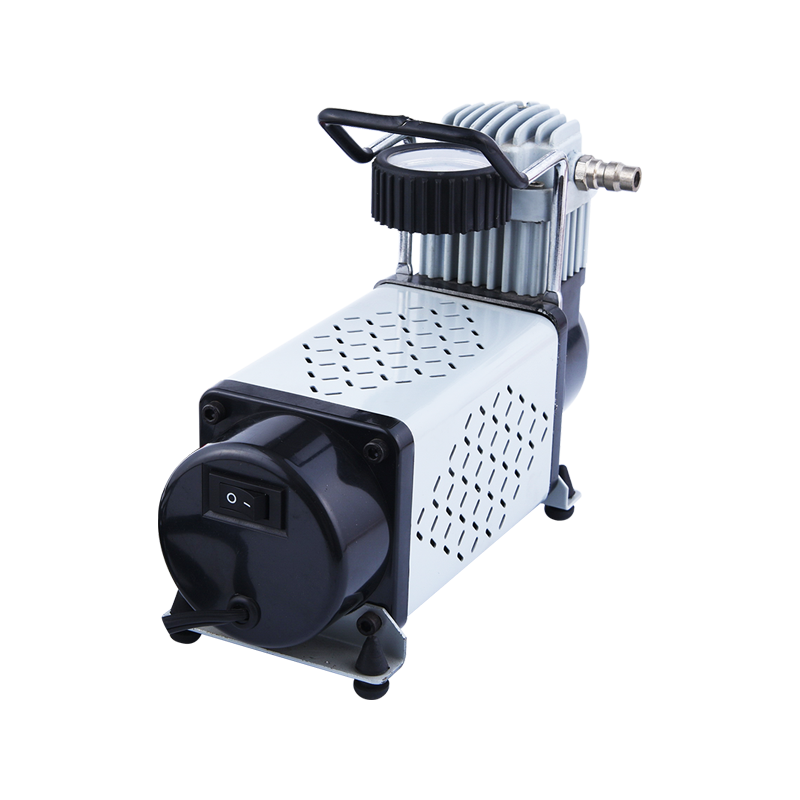 Portable Vehicle Air Pump with Digital Pressure GaugeA digital gauge offers clear, accurate pressure readings for routine tire fills, making it a simple grab-and-go option for everyday passenger cars. Its straightforward design suits drivers who prefer quick, precise inflation.View Product →
Large-cylinder pumps for high-volume work
If you fill truck, SUV, or off-road tires, a larger cylinder moves more air per stroke. A 30 mm cylinder pump finishes a truck tire in roughly half the time of a compact unit and stays cooler while doing it.
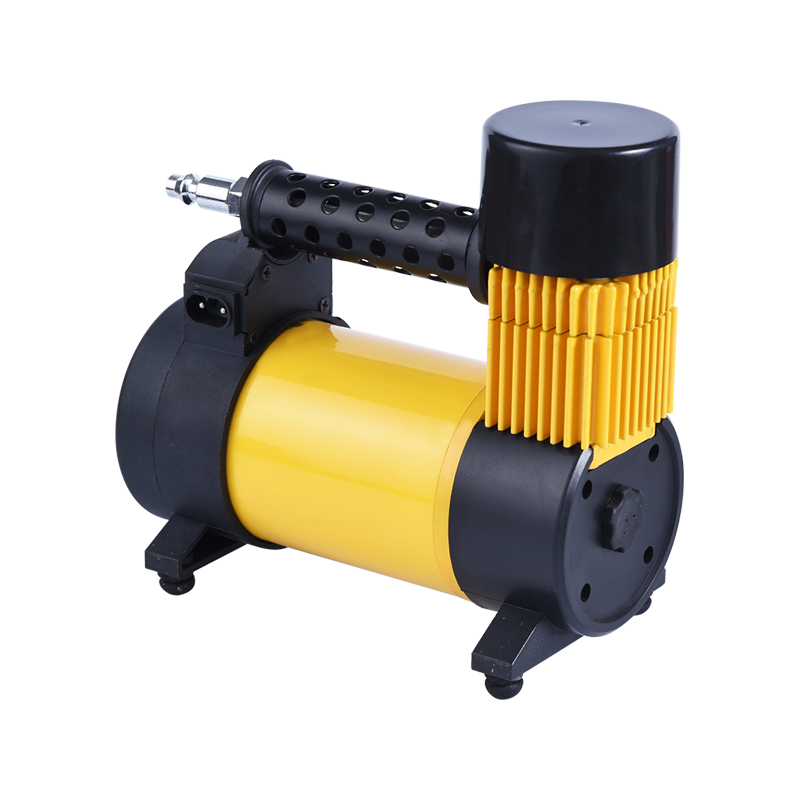 Portable Vehicle Air Pump with 30mm Large CylinderThe 30mm cylinder moves more air per stroke, cutting inflation time for truck, SUV, or off-road tires by roughly half while staying cooler during operation. A practical choice for heavier tires.View Product →
Frequently Asked Questions
What PSI should I set for my car tires?
Check the placard on the driver's door jamb or fuel filler flap. Most passenger cars list a cold target of 30-35 PSI. The sidewall number is the maximum safe pressure, not the recommended operating pressure.
Can I use a portable air compressor while the car is off?
Yes, but it is risky. A 12V pump draws 10-15 amps, and a few minutes with the engine off can drain a borderline battery. Start the engine, or use a rechargeable unit.
How long does it take to inflate a car tire?
On a mid-size sedan, a 30 L/min pump raises a tire from about 28 to 32 PSI in roughly two to three minutes. Truck tires can take five minutes or more; lower flow rates mean longer fills.
Are the digital gauges on portable compressors accurate?
Consumer digital gauges are generally repeatable within 1-2 PSI. A monthly cross-check against a separate quality gauge protects you from a sensor that drifts.
Can a portable compressor inflate a completely flat tire?
Only if the tire bead is still seated and the tire holds air. If the tire was driven flat and the bead came off the rim, a small portable unit cannot reseat it.