English
 Português
 عربى
عربى 中文简体
中文简体A portable air compressor works by using an electric motor to drive a piston inside a small cylinder. The piston pulls ambient air in, squeezes it to a higher pressure, and pushes the compressed air through a hose into your tire. In simple terms, it is a compact electric pump that converts 12-volt power into air pressure, and it repeats a three-part cycle—intake, compression, and delivery—until the target pressure is reached.
That core principle is the same whether you buy an inexpensive model or a premium unit. What differs is how fast the pump cycles, how high a pressure it can hold, how accurately it measures the tyre pressure, and how long it can run before the motor overheats. Understanding those four variables will help you pick the right machine and use it without damaging it.
Content
- How Does a Portable Air Compressor Work?
- Key Components of a Portable Air Compressor
- How to Use a Portable Air Compressor Step by Step
- Piston Compressors vs. Other Portable Designs
- PSI, Flow Rate, and Duty Cycle: What the Numbers Mean
- Why Some Compressors Inflate Faster Than Others
- Pressure Accuracy and Automatic Shut-Off
- Using and Maintaining a Portable Air Compressor Safely
- How to Choose a Portable Air Compressor
- Frequently Asked Questions
How Does a Portable Air Compressor Work?
A portable air compressor works in three stages—intake, compression, and delivery—and it repeats that cycle until the tire reaches the target pressure.
Intake. The piston moves down inside the cylinder, which lowers the air pressure in the cylinder. The atmospheric pressure outside is now higher, so air pushes through the intake port or filter and fills the space above the piston.
Compression. The motor and crank reverse the piston direction, moving it upward. The intake valve closes, sealing the air inside the cylinder. As the piston rises, it squeezes the air into a smaller volume, and this raises its pressure significantly.
Delivery. Once the cylinder pressure is higher than the pressure in the hose and the tire, the outlet check valve opens. The compressed air leaves the cylinder and flows through the hose into the tire. Then the piston begins its downward stroke again, the outlet valve closes, and the cycle restarts.
The motor keeps turning as long as the switch is on or until the pressure control circuit reaches the preset value. Most portable models also include a one-way check valve at the outlet, so air cannot flow backward out of the tire and into the pump when you disconnect the hose.
Key Components of a Portable Air Compressor
The performance of a portable air compressor depends on a small set of mechanical parts: the motor, the piston-and-cylinder assembly, the intake filter, the check valve, and the pressure gauge.
| Component | Role | Fault that reduces performance |
|---|---|---|
| Electric motor | Converts electrical power from a 12V socket or internal battery into rotary motion. | Weak motor leads to slow cycling and heat build-up. |
| Piston and cylinder | Compress air by reducing the volume above the piston. | Cylinder wear or seal failure causes pressure loss. |
| Intake filter or valve | Filters dust before air enters the cylinder. | Clogged filter restricts flow, making the pump slower. |
| Check valve | One-way valve on the outlet that keeps compressed air from flowing backward into the pump. | Leaking valve causes pressure drop and inaccurate inflation. |
| Pressure gauge | Shows pressure in the tire while filling. | Mechanical gauges can drift; a faulty gauge leads to under- or over-inflation. |
When you inspect a portable air pump, these are the parts to look for. A metal cylinder and a well-seated piston generally last much longer than weak plastic assemblies, which is why professional-use models are often heavier.
How to Use a Portable Air Compressor Step by Step
Operating a portable compressor is a simple six-step process, and following it in order protects both the user and the unit.
- Connect the power cord to the 12V socket or ensure the internal battery is charged. For 24V trucks, make sure the compressor is rated for that voltage.
- Remove the valve cap from the tire and firmly press the chuck or thread-on connector onto the valve stem.
- Set the target pressure if the gauge is digital. With a mechanical gauge, note the current reading so you can compare it during inflation.
- Switch on the motor and watch the gauge. A warm-up of one or two seconds while the cylinder fills is normal.
- Wait for auto shut-off if the model has it; otherwise, switch off manually as soon as the reading reaches the recommended pressure. Do not walk away during this step.
- Remove the chuck, reinstall the valve cap, and store the hose and compressor in a dry place.
Most flat tires can be topped up in three to six minutes with a 12V compressor, but the exact time depends on the tire volume, the starting pressure, and the flow rating of the pump.
Piston Compressors vs. Other Portable Designs
Most portable air compressors use a single-stage piston design, which is the correct choice for tire inflation because it offers the best balance of pressure capacity, size, and cost.
There are, however, a few other arrangements. Diaphragm compressors use a flexible membrane that vibrates or oscillates to move air; they are quieter but normally suited for low-pressure items like air mattresses or pool toys. Twin-piston or large-cylinder piston models increase displaced volume per revolution.
| Design | Working principle | Best for | Typical max pressure |
|---|---|---|---|
| Single-piston 12V unit | One piston compresses air in a single cylinder | Car, bike, sports balls | 80–150 psi |
| Twin-piston or large-bore unit | Two cylinders or one wide cylinder move more air per stroke | SUV and light truck tires | 100–150 psi |
| Diaphragm unit | Flexible membrane pushes air without oil lubrication | Air beds, inflatables, low pressure | Usually 40–60 psi |
For everyday car and bicycle tire use, the single-cylinder piston layout is reliable and compact. If you regularly fill large tires, choose a large-cylinder or twin-cylinder piston model; it moves more air per stroke and makes the job noticeably faster.
PSI, Flow Rate, and Duty Cycle: What the Numbers Mean
Three numbers—maximum PSI, flow rate, and duty cycle—together define the capability of a portable air compressor, not any single specification on the box.
Maximum PSI is the highest pressure the compressor can generate before the internal pressure relief stops the motor. It is a ceiling, not a measure of speed. A car tire needs only about 30 to 40 psi, but a truck tire may need 80 psi or more, so check the max rating against your largest tire.
Flow rate, expressed in litres per minute (L/min) or cubic feet per minute (CFM), tells you how much air moves through the hose each minute. Higher flow fills a tire faster. Two compressors with the same PSI rating can still be very different: one may top up a car tire in two minutes and the other in five.
Duty cycle is the ratio of running time to resting time that the motor was designed for, usually stated as a percentage. A 50% duty cycle means the pump should run for a limited period, for example 10 minutes, and then rest for 10 minutes. Overrunning this cycle risks overheating the motor and damaging the piston seals.
| Application | Target pressure |
|---|---|
| Road bicycle tire | 80–120 psi, depending on rider weight |
| Car tyre (sedan) | 30–35 psi |
| SUV or large wagon | 33–40 psi |
| Light truck or van | 55–80 psi |
| Basketball / sports ball | 7–9 psi |
For a typical 16-inch car tire, a mid-range 12V piston compressor with a flow of about 30 L/min will add roughly 6–7 psi in three minutes. A large-cylinder unit can do the same job in roughly half that time.
Why Some Compressors Inflate Faster Than Others
Inflation speed is driven by piston displacement, motor output, and the efficiency of the internal air path, rather than by the PSI printed on the box.
Piston displacement is the most physical factor: a wider cylinder bore or a longer stroke moves more air with each cycle. Motor output decides how fast the crank can turn while working against pressure; a 13-amp motor will simply cycle faster than a 5-amp motor. Air path efficiency covers intake filtering, valve size, interconnecting ports, and fitting diameters—every restriction that makes the pump work harder.
For example, a unit with a 30 mm cylinder bore, such as the HC668, moves noticeably more air with each stroke and is a sensible pick for van or SUV tires.
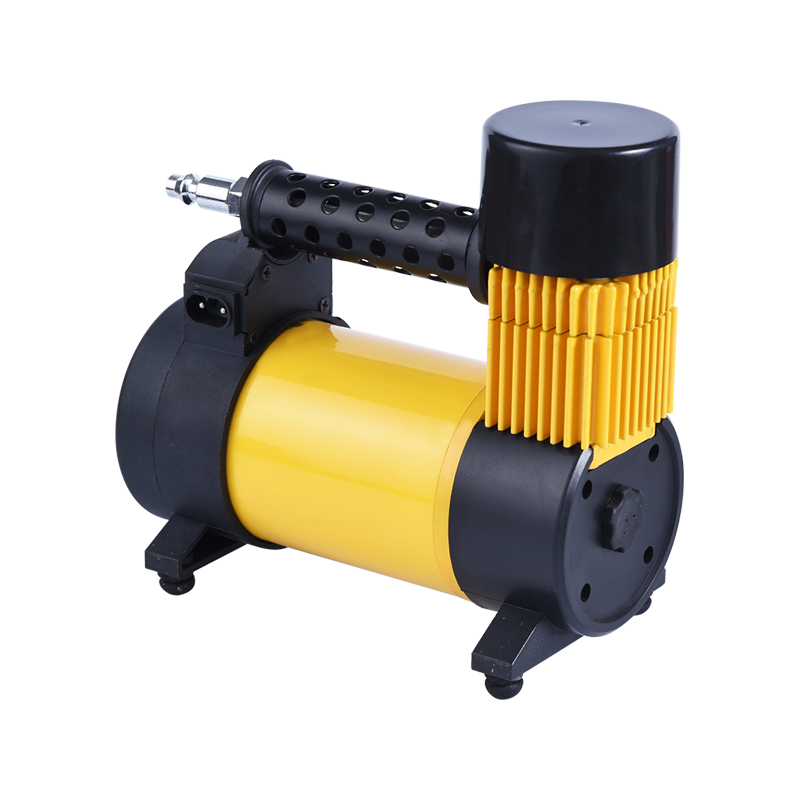 HC668 30mm Large Cylinder Vehicle Air PumpThis pump features a large 30mm cylinder bore, which helps move more air per stroke, making it a practical option for inflating van or SUV tires efficiently.View Product →
Efficiency matters just as much as raw motor power. Seals that fit tightly reduce backward leakage, a smooth cylinder surface lowers friction, and properly sized outlet ports keep pressure loss low. For a closer look at how internal design choices change real-world performance, our article on high-efficiency design and inflation speed explains why two compressors with the same PSI rating can finish the same tire at very different times.
Pressure Accuracy and Automatic Shut-Off
Automatic shut-off is the feature that adds the most convenience to a portable compressor, because it stops the motor at a preset pressure and prevents over-inflation.
Mechanical gauges use a simple dial; they are inexpensive but can drift over time and are easy to misread at small increments. Digital gauges sample pressure from a sensor and show precise values. Some digital models let you set a target pressure, and the control circuit cuts power automatically when the reading reaches that value.
A digital gauge model, such as the HC6593, reads in small increments, shows the target pressure, and cuts power when that number is reached.
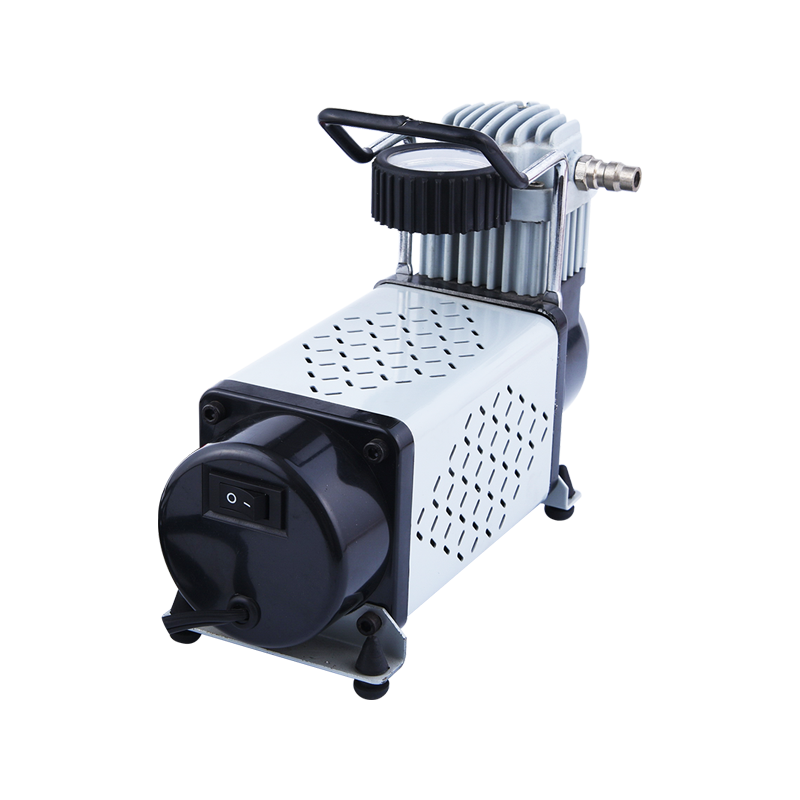 HC659-3 Portable Air Pump with Digital Pressure GaugeEquipped with a digital gauge, this portable pump reads pressure in small increments, displays the target pressure, and automatically stops power to prevent over-inflation.View Product →
Why this matters: portable compressors are usually used at the roadside, in the dark, or with a cold tire. If you have to estimate when to stop, you will under-inflate, over-inflate, or waste time. A reliable auto stop takes that guesswork out and also protects the pump from overrunning when the tire is already close to target.
Using and Maintaining a Portable Air Compressor Safely
Safe operation comes down to three habits: respect the duty cycle, monitor the pressure, and store the compressor in a dry, moderate-temperature place.
- Respect the duty cycle. If the label says 50% duty at 10 minutes, run no longer than 10 minutes in a row, then allow at least 10 minutes for cooling. The motor needs airflow across its housing to shed heat.
- Monitor pressure. Even with auto shut-off, watch the gauge during operation; a faulty sensor or a leaking hose can cause unexpected readings.
- Check the filter. The inlet filter traps dust. A clogged filter strangles airflow and makes the pump overwork, so clean it periodically with compressed air or replace it if needed.
- Inspect the hose and chuck. Cracks on the hose or a loose chuck allow leaks and make the compressor run longer than necessary.
- Store it properly. Heat builds up in a closed vehicle in summer and can warp plastic parts or damage battery packs. Keep the unit in a cool, dry area, ideally inside the cabin rather than in a hot trunk.
Also avoid powering a compressor intended for 12V operation from a 24V truck socket unless the device is rated for dual voltage. Wrong voltage can burn out the motor immediately.
How to Choose a Portable Air Compressor
Choose a portable air compressor by matching its maximum pressure, flow rate, and power source to the largest tire you intend to inflate.
- Define the largest job. A bicycle-only user needs low flow but high PSI; a sedan owner needs moderate PSI and moderate flow; a van or SUV owner needs both high PSI and higher flow.
- Check the power source. 12V cigarette-lighter models are fine for most passenger cars. For trucks with 24V electrical systems, look for a dual-voltage unit or one with battery clamps. Battery-integrated models are cordless and convenient, but their capacity limits the number of fills.
- Look at flow rate first, max PSI second. Flow determines speed; max PSI is only a ceiling. A 150 psi compressor with 20 L/min flow will be slower than a 120 psi compressor with 40 L/min for a normal car tire.
- Prefer a digital gauge with auto shut-off. Accuracy and cut-off make the process safer and easier, especially at night.
- Check the accessories. A tapered nozzle for sports balls, a valve adapter for the common Presta or Schrader systems, and a long flexible hose add significant value.
Multi-function kits such as the HC640 combine a dependable piston pump, an integrated pressure gauge, a flexible hose, and adapter nozzles in a single case, which simplifies roadside use.
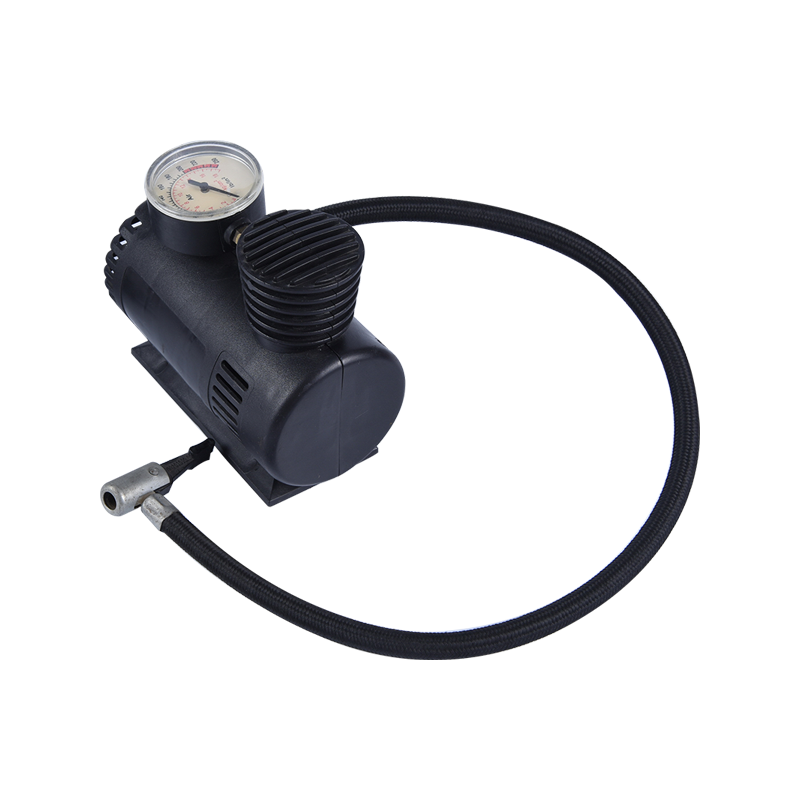 HC640 Multi-Functional Vehicle Air Pump KitThis multi-functional kit combines a piston pump, integrated pressure gauge, flexible hose, and adapter nozzles in one case, simplifying roadside tire inflation tasks.View Product →
If you regularly inflate large tires, give priority to a large cylinder, as this reduces working time and keeps the motor within its duty cycle more easily.
Frequently Asked Questions
Here are the answers to the most common questions about portable air compressors.
Is a portable tire compressor a real air compressor?
Yes, it is. The term "air compressor" applies to any device that raises the pressure of air by reducing its volume, and that is exactly what the piston-and-cylinder assembly inside a portable unit does. The difference is scale: a portable compressor has a small motor that can run for only a portion of each hour, so it is not designed for continuous air tools.
Does a higher PSI rating mean faster inflation?
No. Maximum PSI is the highest pressure the unit can produce, not the speed at which it produces air. Inflation speed depends on flow rate, typically measured in L/min, which is determined by motor power and cylinder displacement. You can have a compact compressor rated at 150 psi that inflates a car tire slowly because its flow is small.
Can I leave a portable air compressor running unattended?
It is not advisable. Even with automatic shut-off, you should stay close enough to hear the motor, watch the gauge, and respond to an unexpected event such as a cut hose or a faulty sensor. Accidental over-inflation can damage a tire or cause personal injury.
Can I use the same compressor for car tires and camping inflatables?
Yes, as long as you change the target pressure and use the correct nozzle. Air mattresses, pool toys, and balls need only a few psi; car tires need 30 psi or more. Set the cut-off pressure accordingly to avoid bursting the inflatable.
Why must I let the compressor rest between uses?
Resting prevents overheating. The motor, piston seal, and valve components generate friction heat during operation. If you let the temperature rise beyond design limits, seals soften, lubricant breaks down, and permanent damage can occur. The duty cycle number is the manufacturer's safe repetition rate, so following it is the simplest way to extend the life of the pump.
A portable air compressor is essentially a small electric piston pump: the motor spins, the piston moves up and down, and compressed air is forced through a hose into your tire. The reliable choice for everyday car and bike use is a single-cylinder piston model with adequate maximum pressure, acceptable flow, and a sensible duty cycle. When you are ready to buy, match the compressor to your largest tire, prefer a digital gauge with automatic shut-off, and always stop before the pump overheats. That way, the tool stays reliable for years.