English
 Português
 عربى
عربى 中文简体
中文简体A high CFM portable air compressor earns its place in the trunk only when the flow figure is tied to a pressure, a power source, and a duty cycle. CFM means cubic feet per minute, the volume of air a pump moves in one minute. A 12 V unit advertised at 3 CFM at 0 PSI normally delivers about half of that once it is pushing against 30 PSI of tire pressure, and the working-pressure number decides whether a top-off takes two minutes or twelve.
The short version: for passenger cars, 1.0 to 1.5 CFM at 30 PSI is comfortable. For light trucks, vans, and off-road tires, aim for roughly 2 CFM at 30 PSI or more, and expect to feed that pump from battery clamps rather than a cigarette lighter socket. Cylinder bore, current draw, and duty cycle are the three details that decide whether a big flow number survives contact with a real tire.
Content
- What "High CFM" Actually Means in a 12 V Compressor
- The Two Hardware Levers Behind Real CFM: Bore and Current
- Power Source: Why the 12 V Socket Sets the Ceiling
- Matching Flow to the Job, Not to the Vehicle
- Duty Cycle and Heat Soak: The Limit Nobody Prints in Bold
- Gauges, Chucks, and Hose Diameter: Small Details That Decide Real Speed
- A Two-Minute Buying Checklist
- Frequently Asked Questions
What "High CFM" Actually Means in a 12 V Compressor
CFM only means something when it is quoted together with the pressure it was measured at, so treat a bare flow number as a starting point rather than a specification. Manufacturers normally publish two figures: free flow at 0 PSI, the largest number the pump can produce with nothing resisting it, and flow at a working pressure such as 30 PSI, which is much closer to what happens at a valve stem.
Flow drops as pressure rises because the piston compresses against increasing back pressure, volumetric efficiency slips, and the motor slows under load. A pump can therefore fill the first half of a tire briskly and crawl through the last 10 PSI of a light-truck tire.
One sanity check works well: pressure multiplied by flow equals the air power delivered. Moving 3 cubic feet per minute against 40 PSI takes far more than the 180 W available from a socket on a 15 A fuse, so very high CFM claims almost always describe free flow.
| Rating point | Compact 12 V pump (10-15 A) | Heavy-duty 12 V pump (20 A+) | What it tells you |
|---|---|---|---|
| Flow at 0 PSI (free flow) | 0.8-1.5 CFM | 2.0-3.0 CFM | Largest number the pump can produce with no back pressure; mostly an advertising figure |
| Flow at 30 PSI | 0.5-0.9 CFM | 1.3-2.0 CFM | Realistic top-off speed for a passenger-car tire |
| Flow at 40 PSI and above | 0.4-0.7 CFM | 1.0-1.5 CFM | Decides how long light-truck and off-road tires take |
The Two Hardware Levers Behind Real CFM: Bore and Current
Real flow comes from two hardware decisions, and everything else is packaging: a larger cylinder bore and a motor that is allowed to draw more current.
A bigger bore sweeps more air per stroke, which is why a 30 mm large-cylinder pump moves noticeably more volume than a compact unit at the same pressure. A longer stroke, tighter reed valves, and a rigid cylinder wall protect that volume as pressure climbs. Electrically, the motor needs permission to pull current: 15 A at 12 V is about 180 W, while a pump wired for 20 to 25 A can use 240 to 300 W and feels roughly twice as quick on a 33-inch tire.
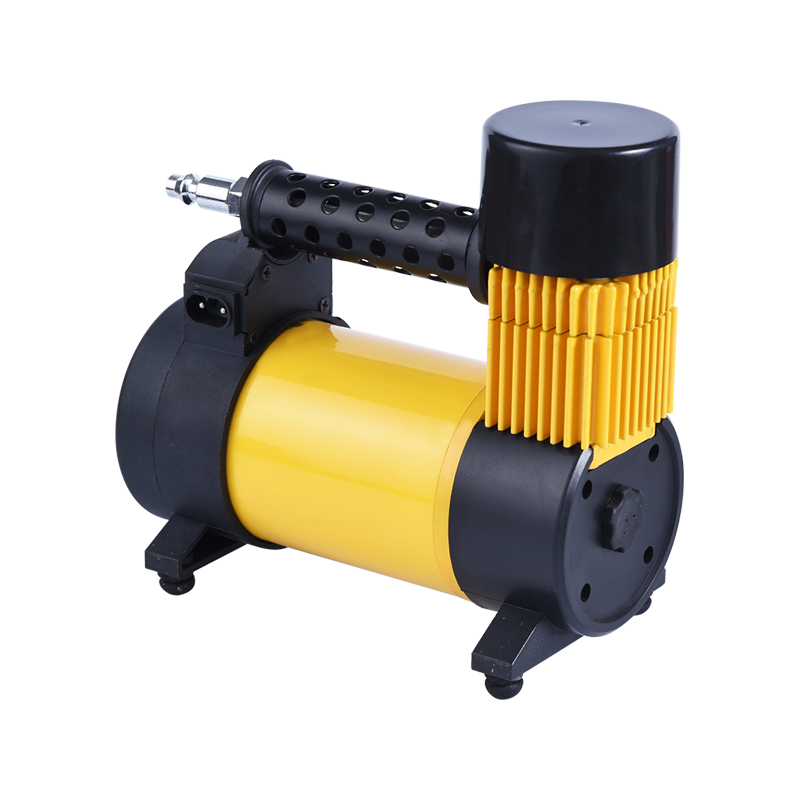 HC668 30mm Large-Cylinder Vehicle Air Pump for Faster Tire InflationA 30mm cylinder, metal gauge, and included adapters make this pump relevant for higher-volume car, bike, and inflatable inflation where airflow and heat trade-offs matter.View Product →
The trade-off is heat, because more current and a larger swept volume mean more waste heat in the windings and the head. Design work in this category concentrates on air per watt, which is why analysis of how pump efficiency affects inflation speed keeps returning to valve timing, cooling, and motor load instead of headline flow numbers.
Power Source: Why the 12 V Socket Sets the Ceiling
The bottleneck in most cars is the socket rather than the pump, and that single constraint explains more disappointing inflation times than any other factor.
Cigarette lighter circuits are usually fused at 15 A, which caps the pump at roughly 180 W; a few vehicles allow 20 A through a dedicated accessory socket. Above that limit the fuse blows, the plug gets hot, and voltage at the pump sags, so the motor turns slower and flow falls. Pumps fitted with battery clamps can draw 20 to 25 A straight from the battery and hold their flow far longer.
Three rules cover most situations. Check the fuse rating of the socket circuit before buying a pump that draws more than 15 A. Use battery clamps for light-truck tires or several vehicles in one session. Keep the engine running so the battery is not carrying the load alone.
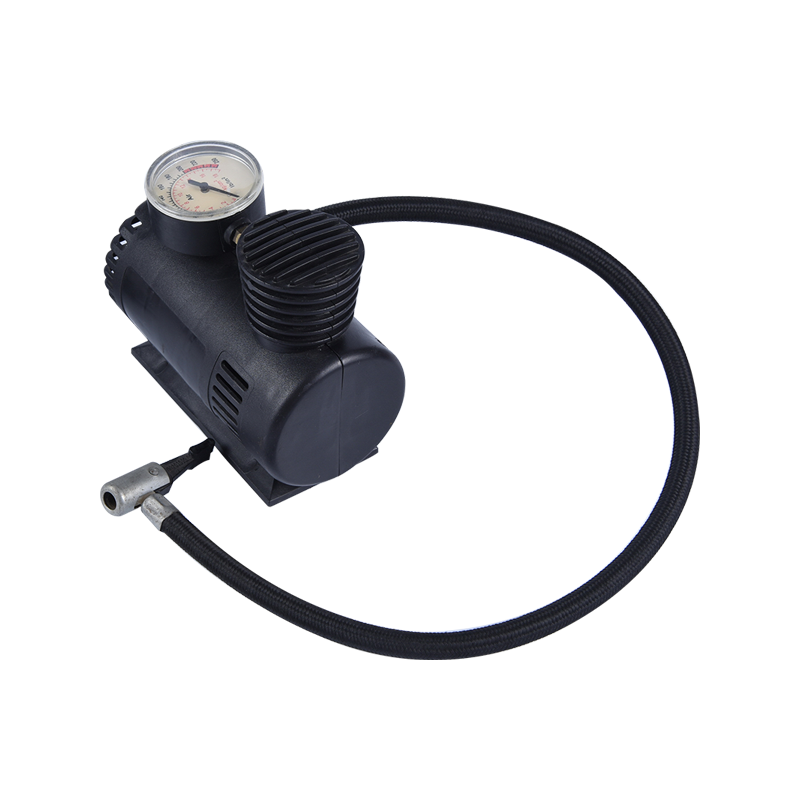 HC640 Multi-Functional Vehicle Air Pump for Cigarette-Lighter Everyday InflationRuns from a standard cigarette-lighter socket for routine car, SUV, bike, and ball inflation, making it a practical portable choice without external power or clamps.View Product →
When the socket can take the load, a multifunctional unit such as the HC640 is the sensible one to leave in the car: it runs from a standard cigarette lighter plug and covers everyday inflation work without extra wiring.
Matching Flow to the Job, Not to the Vehicle
Match CFM to the volume of air you actually have to move, not to the badge on the hood, and the choice becomes straightforward: a passenger tire top-off is a small job, a set of light-truck tires is a large one, and the gap is measured in minutes.
The volume inside a tire scales with diameter and width. A 205/55R16 holds roughly 1.5 cubic feet of air; an LT285/75R16 holds about twice that. Adding 5 PSI to a small tire means moving about 0.5 cubic feet of atmospheric-pressure air, while taking a 33-inch off-road tire from 0 to 30 PSI means moving around 8 cubic feet.
| Job | Air to add | Time at about 1 CFM (30 PSI) | Time at about 2 CFM (30 PSI) |
|---|---|---|---|
| Top-off, 205/55R16, plus 5 PSI | 0.5 cubic feet | 1 minute or less | Under 1 minute |
| Light truck, LT285/75R16, plus 15 PSI | 3.5-4 cubic feet | 4-6 minutes | 2-3 minutes |
| Off-road tire, 33 inch, 0 to 30 PSI | About 8 cubic feet | 10-14 minutes | 6-8 minutes |
The practical cut-off is simple: if your tires are LT-rated or larger than 33 inches, buy for 2 CFM at 30 PSI or better. The current range of 12 V vehicle air pumps covers both ends of that scale, from compact plugs for passenger cars to 30 mm-bore units built for trucks and off-road use.
Duty Cycle and Heat Soak: The Limit Nobody Prints in Bold
Duty cycle, not CFM, is what usually stops a fast pump halfway through a job, and it is the specification buyers read last.
Duty cycle is running time against rest time, and it tracks how well the motor and head shed heat:
- Compact 12 V pumps: often 10 minutes on and 30 minutes off, with plastic heads that warm quickly.
- Mid-weight units: around 20 to 25 minutes on and 15 to 20 off, usually with a metal head.
- Heavy-duty units with a metal head and fan: 30 to 40 minutes continuous before a thermal cut-out steps in.
In practice, inflate in rounds of two tires, feel the head between rounds, keep the hose uncoiled so heat escapes, and let the pump cool before it goes back in the trunk. A pump that cuts out mid-job is not broken; it is protecting its windings.
Gauges, Chucks, and Hose Diameter: Small Details That Decide Real Speed
An accurate gauge and a chuck that stays put feel like extra CFM, because you stop re-checking and finish the job.
Mechanical gauges commonly read within 2 to 5 PSI, which matters when a small error sends you back to the valve stem twice. A digital gauge holds within about 1 PSI and removes most of that guesswork. The connector matters just as much: a locking or clip-on chuck frees both hands and leaks less than a pressed-on one, while a thin-bore hose or three quick-connects in the line quietly eat flow at 40 PSI.
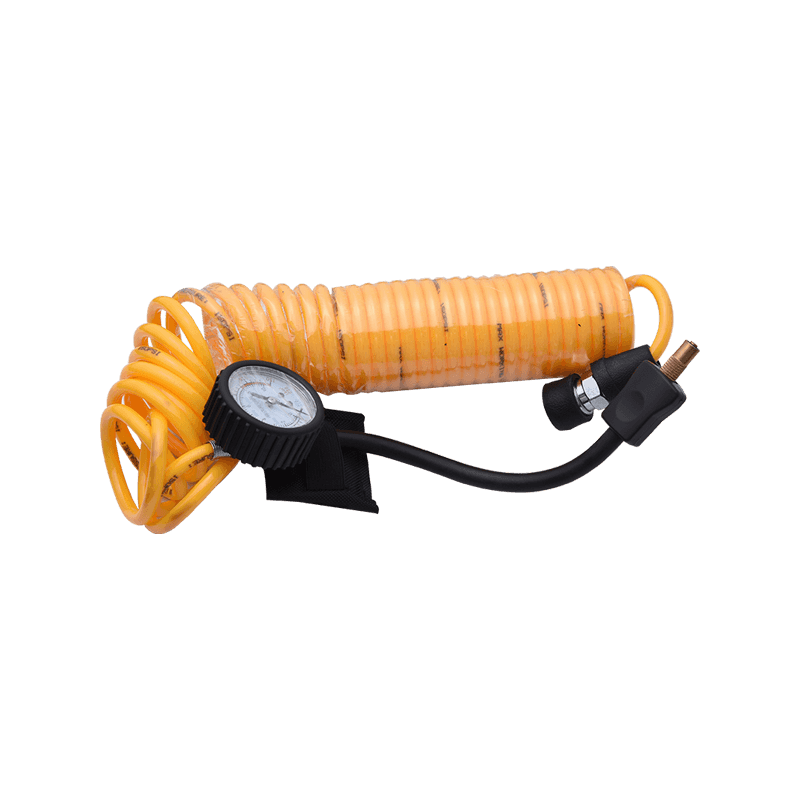 HC673 DC Vehicle Air Pump with Digital Pressure Gauge and Auto-StopA 150 PSI metal compressor with digital target-pressure auto-stop and clip-equipped cord, suited to car, motorcycle, ATV, bike, and inflatable inflation where gauge accuracy matters.View Product →
Pumps built around a digital pressure reading, such as the HC673 DC vehicle air pump, target exactly that problem, so the first reading is one you can trust.
A Two-Minute Buying Checklist
Six checks cover almost every mistake people make with portable compressors.
- Find a CFM figure quoted at 30 PSI. If only free flow at 0 PSI is listed, assume roughly half in real use.
- Compare the amp draw with the fuse rating of the socket you plan to use, or plan on battery clamps.
- Check the duty cycle against your worst case, such as four light-truck tires at plus 10 PSI each.
- Confirm the maximum pressure leaves margin above your target, for example a 150 PSI rating for a 60 PSI job.
- Inspect the chuck and hose: locking connector, reasonable bore, workable length.
- Decide whether you need extras such as a set-pressure auto stop, a work light, or a storage bag.
Frequently Asked Questions
Is 1.5 CFM at 30 PSI enough for a light-truck tire?
It is enough for top-offs of 5 to 10 PSI, but budget five to seven minutes per tire, and treat filling a large tire from flat as a battery-clamp job rather than a roadside one.
Can a high CFM compressor run from a cigarette lighter socket?
Only while its draw stays under the circuit fuse, usually 15 A. Anything above that needs battery clamps, and most genuinely high-flow models are wired that way on purpose.
Why does my compressor slow down above 40 PSI?
Because flow and pressure trade off inside the same motor. As back pressure rises the piston works harder, the motor turns slower, and the pump delivers less air per minute, which is normal behaviour rather than a fault.
Do I need an air tank on a portable compressor?
A small tank smooths the pulse and gives a burst of stored air, which helps for blowing out lines and running small tools, but it adds weight and bulk to something you carry in a trunk.
A high CFM portable air compressor is bought against a specific job: passenger-car top-offs, a set of light-truck tires before a trip, or an off-road tire coming back up from trail pressure. Choose the flow rating at 30 PSI that beats that job, confirm the pump is allowed to draw the current it needs, and check the duty cycle. Bore, amps, and cooling are what make the number on the box real.