English
 Português
 عربى
 中文简体
Two tires down on a gravel shoulder at 6 a.m. is the real test of a 12V portable air compressor. The unit that gets you moving again is rarely the one with the biggest number on the box; it is the one whose duty cycle lasts long enough to finish the job before the thermal cutout fires.
Short answer: the best 12V portable air compressor for most drivers delivers a working pressure above 150 PSI, genuine flow near 1.0-1.5 CFM at 30 PSI, a 10-15 amp draw through battery clamps or a heavy-gauge plug, and a gauge accurate to within 1-2 PSI. Everything else on the label is packaging.
The rest of this guide explains why those four numbers decide the outcome, and how they change with the tires you actually drive on.
Content
- What "Best" Actually Means for a 12V Portable Air Compressor
- Decode the Spec Sheet Before You Buy
- Duty Cycle and Fill Time Decide Whether the Job Gets Finished
- Clamps, a 12V Plug, or Its Own Battery?
- Gauge Accuracy and Auto-Shutoff: Small Features With Real Consequences
- Match the Compressor to the Vehicle You Drive
- Choosing a 12V Air Compressor We Build Ourselves
- FAQ: 12V Portable Air Compressor Questions
What "Best" Actually Means for a 12V Portable Air Compressor
Best means one thing in practice: the compressor finishes your tire in a single, uninterrupted run.
A pump that stalls at 28 PSI has failed, even when the box promises 150 PSI. Four specifications decide whether it gets there:
- Duty cycle — minutes of running before thermal protection shuts the motor down. Under 5 minutes is a toy; 10-20 minutes covers a full set of car tires.
- Real airflow — quoted in CFM at a stated pressure. A 1.0 CFM unit fills roughly twice as fast as a 0.5 CFM one, whatever the packaging says.
- Working pressure — the pressure it can still push air at, not the peak it touches once and cannot hold.
- Power path — clamps, a 12V socket plug or an internal battery. Each has a different current limit and a different failure mode.
Portability counts too: it should fit a spare-wheel well, weigh under about 4 kg, and work in the rain without lifting the hood.
Decode the Spec Sheet Before You Buy
The number printed largest on the box is usually the least useful one.
| Label claim | What it really means | What to look for |
|---|---|---|
| Peak PSI (150, 250 and up) | Maximum pressure reached with no load; it cannot be sustained while air is moving | A working pressure of at least 100 PSI at usable flow |
| Flow rate in CFM or L/min | Usually a free-flow figure, so real output falls as pressure rises | Flow quoted at a real pressure, for example 1.0-1.5 CFM at 30 PSI |
| Ampere draw | Decides whether the vehicle's 12V socket fuse survives the job | 10-15 A for clamp-on units; below 10 A for socket-powered units |
| Duty cycle | Continuous running time before the thermal cutout trips | 10-20 minutes, or a stated continuous rating |
If a listing shows only a PSI figure and nothing on flow, current or duty cycle, treat the missing data as the answer.
Duty Cycle and Fill Time Decide Whether the Job Gets Finished
Duty cycle is what separates a useful compressor from a frustrating one, because every other number can be satisfied before the thermal cutout fires.
Fill time tracks tire volume, not pressure claims. A typical 1.0 CFM 12V compressor behaves roughly like this:
| Tire and vehicle | Time from 0 to 32 PSI | Minimum useful duty cycle |
|---|---|---|
| 195/65R15 compact car | 2.5-3.5 minutes | 5 minutes |
| 225/45R17 sedan or crossover | 3-4 minutes | 8 minutes |
| 265/70R17 pickup or van | 5-7 minutes | 15 minutes |
| 33-35 inch off-road tire | 8-14 minutes per tire | Continuous, or 30 minutes and above |
Read that table with your own vehicle in mind. Topping up four car tires by 4 PSI twice a season needs a very different machine from airing down to 18 PSI on sand and back up again at the trailhead. Buying the small unit for the heavy job is the standard mistake here — the motor shuts off with the tire still low.
Clamps, a 12V Plug, or Its Own Battery?
Battery clamps are the safest choice for anything larger than a compact car tire, because they bypass the fuse-protected socket entirely.
- Battery clamps: draw 15-30 A straight from the battery, fill fastest, and work on any 12V vehicle. You must open the hood, and polarity still matters.
- 12V socket plug: clean and convenient, but limited to roughly 10-15 A, which caps real output. Fine for car tires, slow on truck tires.
- Rechargeable battery: tidiest for short top-ups, bicycles and balls, but a cold lithium pack loses capacity quickly, and an empty internal battery means no inflation at all.
Two habits are worth keeping: run the engine while you inflate, so the compressor works off the alternator rather than the battery, and never re-seat a warm plug — 12V connectors run hot by design.
Gauge Accuracy and Auto-Shutoff: Small Features With Real Consequences
A compressor is only as good as the number it reports, so judge the gauge as seriously as the motor.
Analogue dials on inexpensive units routinely read 3-5 PSI high or low and drift further in the cold. Digital gauges with a stated tolerance of 1-2 PSI, or a preset auto-shutoff that stops the motor at your target, remove the guesswork and the crouching. Look for the tolerance figure in the specification, not a photograph of a dial.
Auto-shutoff also protects the tire: an unattended analogue pump is how 45 PSI ends up in a 32 PSI tire, and that shows up later as uneven wear.
Match the Compressor to the Vehicle You Drive
The right specification follows tire volume and how often you use it, not brand loyalty.
Daily driver, seasonal top-ups
A 10-15 A unit with a 10-minute duty cycle and a 12V plug covers four car tires, plus the occasional bicycle or ball.
Pickup, van or delivery fleet
Choose clamps and a 15-20 minute duty cycle; repeated daily use on commercial tires punishes undersized motors.
Overlanding, off-road and EV owners
Large tires need volume, not only pressure. On an EV, check the 12V socket fuse rating before plugging in anything.
Choosing a 12V Air Compressor We Build Ourselves
It helps to see how those criteria translate into hardware. Ningbo Kede Electric has built vehicle accessories in Yuyao, Zhejiang since 1992, and its air compressor range covers the three cases above.
Mixed use — car tires plus the occasional bike, ball or air mattress — is the HC640's territory: it runs from a regular 12V socket and keeps a compact footprint.
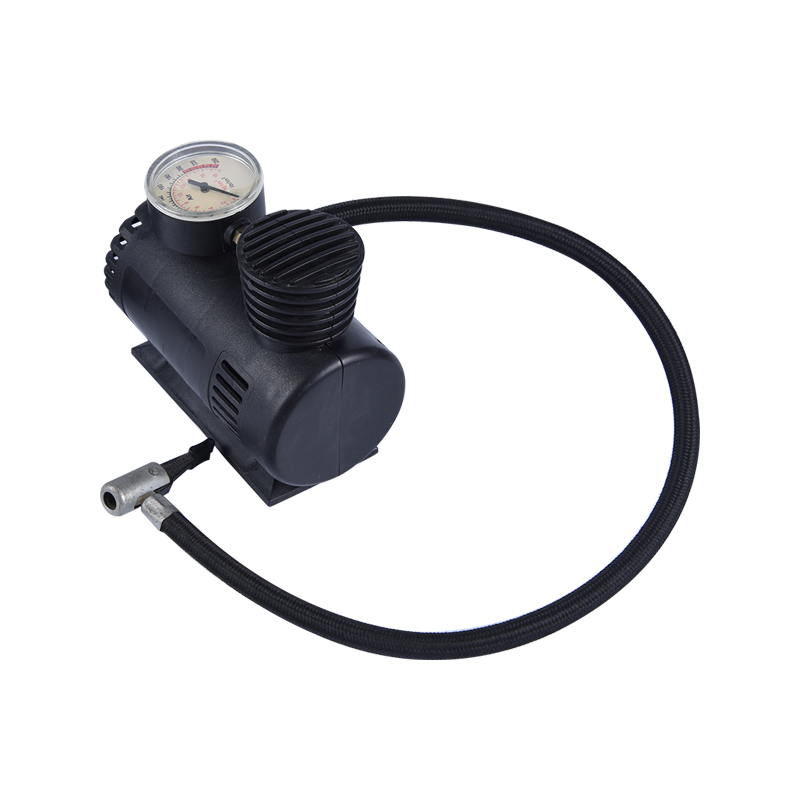 HC640 Multi-Functional Portable 12V Vehicle Air PumpCompact 12V air pump for car tires, bikes, balls, and air mattresses, with built-in gauge and 3-meter cigarette-lighter cord for convenient roadside or garage use.View Product →
To avoid crouching beside the valve, the HC6593 carries a digital pressure gauge, so the target pressure is set and read on screen rather than estimated.
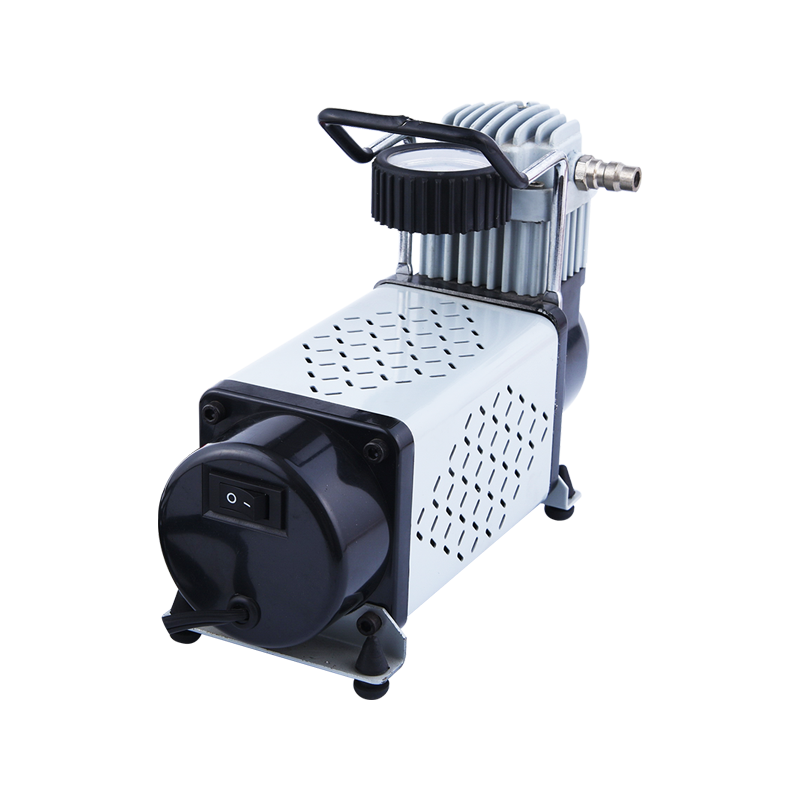 HC659-3 Portable Vehicle Air Pump with Digital Pressure GaugePortable 12V air pump with digital pressure gauge, 150 PSI, 40 mm cylinder, and accessories for tires, balls, and air mattresses.View Product →
For trucks, vans and larger tires, cylinder diameter is the difference between four minutes and eight. The HC668 uses a 30 mm cylinder, and the safety and stability of large-cylinder air pumps is one reason that bore size stays in the range.
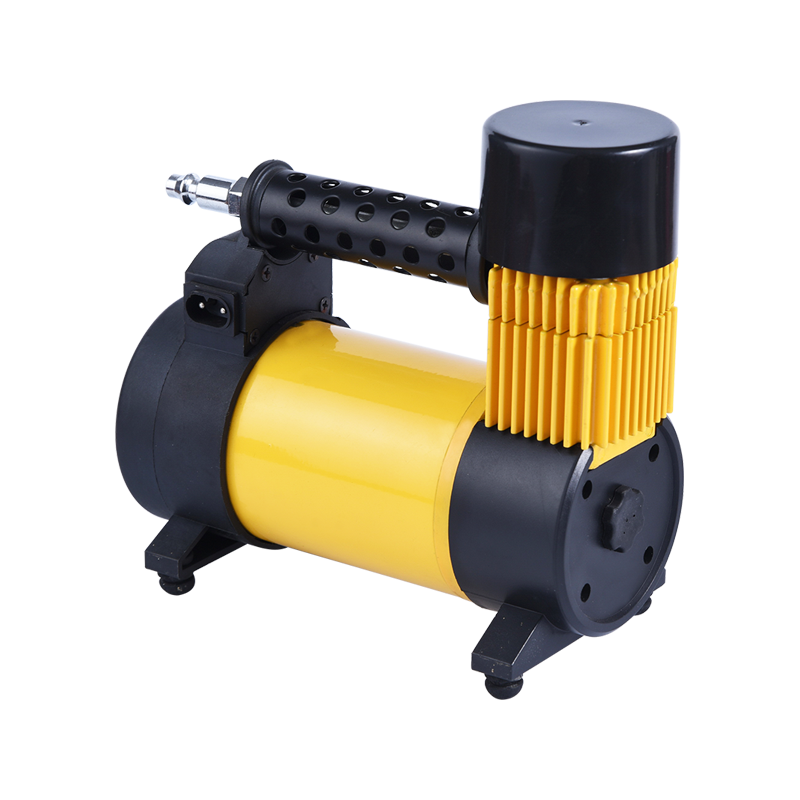 HC668 30mm Large Cylinder Vehicle Air PumpVehicle air pump with 30 mm cylinder, external metal pressure gauge, and accessories for car, truck, motorcycle, bicycle, ball, and mattress inflation.View Product →
FAQ: 12V Portable Air Compressor Questions
Should the engine be running while I use a 12V air compressor?
Yes. Running the engine lets the alternator supply the 10-15 A load instead of the battery, and inflating four tires on battery power alone is a quick route to a jump start.
Can a 12V portable air compressor inflate a completely flat tire?
Yes, but slowly and within the duty cycle. Expect several minutes per tire, pause to let the housing cool, and reseat the valve stem if pressure refuses to climb.
Why does my compressor blow the vehicle's 12V fuse?
Usually because the plug draws more current than the socket is fused for, which is common on cars with 10 A accessory circuits. Move to battery clamps rather than fitting a larger fuse.
Compressed buying advice: match the duty cycle and the connector to your largest tire, insist on a flow figure quoted at a real pressure, and treat the gauge as a measuring instrument rather than decoration. Those three checks remove most of the disappointment in this category.
Then keep the compressor in the vehicle rather than the garage. A modest unit stored under the spare wheel with a coiled hose will earn its place far more often than a better one you left at home.